
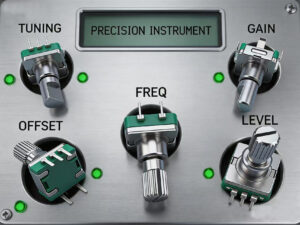
Application of Potentiometers in Precision Instruments
As a core adjustable electronic component, potentiometers, especially precision potentiometers, play an irreplaceable role in modern precision instruments. Based on the basic principle of resistance voltage division, they achieve precise adjustment of circuit parameters by changing the effective resistance length of the resistive track through a moving contact, becoming a key guarantee for the accuracy and stability of precision measurement and control systems.
Precision potentiometers used in precision instruments differ from ordinary consumer-grade products in structure and material selection. Their resistive elements are usually made of high-precision wire-wound, conductive plastic or metal glass glaze materials. Among them, wire-wound potentiometers have the advantages of high precision, good stability and small temperature coefficient, and are suitable for high-power precision calibration scenarios; conductive plastic potentiometers provide excellent linearity and mechanical durability, with a service life of more than 1 million cycles, making them ideal for position feedback scenarios that require frequent adjustment; metal glass glaze potentiometers stand out for their wide resistance range, high temperature resistance and good moisture resistance, and are mostly used in semi-fixed precision adjustment of instrument circuits. To improve adjustment accuracy, most precision potentiometers used in instruments adopt a multi-turn design (5-turn, 10-turn or even higher), which can achieve finer resistance stepping than single-turn products, meeting the strict requirements of precision instruments for parameter adjustment.
In practical application scenarios of precision instruments, potentiometers undertake multiple core functions. The first is sensor signal calibration and adjustment. In various precision sensors such as position sensors, force sensors and temperature sensors installed in testing instruments, potentiometers are used to calibrate zero drift and full-scale output, ensuring that the measurement error of the instrument is controlled within an acceptable range. For example, in joint angle feedback of industrial testing robots, precision conductive plastic potentiometers provide stable angle position signals with a linear error as low as ±0.1%, providing a data basis for precise motion control. The second is circuit parameter trimming in measurement systems. In high-precision voltage measurement and power calibration equipment, potentiometers are used as high-precision voltage dividers to fine-tune the output reference voltage. Early potentiometers were even directly used as precision measuring instruments to compare unknown voltages with known reference voltages, achieving high-precision voltage measurement relying on the accurate calibration of the voltage divider. The third is manual setting and adjustment of instrument functions. In analytical instruments, medical testing equipment and industrial control meters, potentiators are used as interface components for operators to set test parameters, adjust output signals and calibrate instrument status. For example, in infusion pumps and diagnostic instruments in the medical field, precision potentiometers are used to accurately set the infusion flow rate and adjust the signal gain of detection modules, which is related to the safety and accuracy of medical testing. In addition, in high-precision testing and measurement equipment and aerospace measurement and control instruments, sealed precision potentiators can maintain stable contact resistance and performance in harsh environments such as high temperature, high humidity and vibration, ensuring the long-term reliable operation of the instrument.
With the development of precision instruments towards miniaturization and intelligence, surface-mount precision potentiometers and digital potentiometers have also been widely used, but traditional contact precision potentiometers still maintain an irreplaceable position in many high-reliability and high-precision application scenarios due to their simple structure, low cost and stable performance. The continuous improvement of potentiometer manufacturing technology also provides a solid foundation for the continuous improvement of precision instrument performance.